Bush II, Obama, and the Decline of U.S. Hegemony in the Western Hemisphere by Thomas Andrew O'Keefe
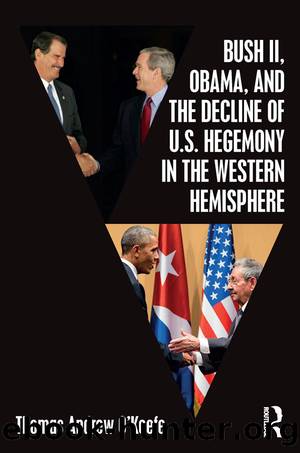
Author:Thomas Andrew O'Keefe [O'Keefe, Thomas Andrew]
Language: eng
Format: epub
ISBN: 9781138080867
Google: nLs4swEACAAJ
Barnesnoble:
Goodreads: 37699418
Publisher: Routledge
Published: 2018-01-15T06:52:08+00:00
The Negotiations become Hopelessly Deadlocked
As had been widely expected, the TNC meeting held in Puebla, Mexico on February 2â6, 2004 was unable to come up with negotiating modalities for the two-tiered approach to the FTAA proposed at the November 2003 Trade Ministerial in Miami. That proposal would have moved the FTAA away from a comprehensive trade agreement whose disciplines would be obligatory for all the signatory states to being one in which all 34 countries would agree to a set of core obligations, while other disciplines would be the subject of plurilateral agreements involving a smaller group of interested countries. The major stumbling block that developed at Puebla was an inability to decide what should be included among the core obligations and the procedures for negotiating the voluntary plurilateral agreements. The MERCOSUR countries insisted that no industrial or agricultural goods could be excluded from the market access provisions of any FTAA. The MERCOSUR countries also pressed for including the elimination of export subsidies, as well as the trade-distorting effects of state-trading enterprises, food aid, and domestic price support systems for agricultural products, in the core obligations. On the other hand, the MERCOSUR countries refused to go beyond WTO commitments on government procurement, intellectual property, investment, and trade in services, and advocated relegating further concessions in those areas to the plurilateral agreements. While the United States did reiterate a previously made commitment to eliminate the use of agricultural export subsidies within the Western Hemisphere, it again insisted that domestic agricultural support payments could only be handled at the WTO. The United States also insisted that government procurement, intellectual property, investment, and services had to be included within the set of core obligations for all 34 countries.
A series of bilateral talks between the co-chairs of the FTAA process, Brazil and the United States, throughout 2004 and early 2005 failed to produce a consensus on what to include in the set of common obligations under the two-tiered âFTAA Liteâ approach. The inability of the G-20 group of developing countries led by Brazil, China, and India to make any headway in the WTO Doha Development Round and obtain meaningful concessions, particularly from the EU, on agricultural subsidies also negatively impacted the FTAA negotiations. Perhaps not surprisingly, the January 1, 2005 date for concluding the FTAA negotiations came and went. An August 2005 effort by Mexico and CARICOM to push for a new TNC meeting before the next scheduled Summit of the Americas in November 2005 was rebuffed by Brazil and the United States. There had been no formal FTAA meetings since the last TNC in Puebla in February 2004 had ended in discord.
The Fourth Summit of the Americas was held in the seaside resort city of Mar del Plata, Argentina on November 4â5, 2005. In the months leading up to the Summit there were doubts that U.S. President George W. Bush would even appear, given the impasse that had developed between the United States and the MERCOSUR countries. Although Bush did show up, he became the focal point of mass demonstrations protesting against the FTAA and U.
Download
This site does not store any files on its server. We only index and link to content provided by other sites. Please contact the content providers to delete copyright contents if any and email us, we'll remove relevant links or contents immediately.
| Arms Control | Diplomacy |
| Security | Trades & Tariffs |
| Treaties | African |
| Asian | Australian & Oceanian |
| Canadian | Caribbean & Latin American |
| European | Middle Eastern |
| Russian & Former Soviet Union |
The Secret History by Donna Tartt(19092)
The Social Justice Warrior Handbook by Lisa De Pasquale(12190)
Thirteen Reasons Why by Jay Asher(8912)
This Is How You Lose Her by Junot Diaz(6887)
Weapons of Math Destruction by Cathy O'Neil(6281)
Zero to One by Peter Thiel(5802)
Beartown by Fredrik Backman(5755)
The Myth of the Strong Leader by Archie Brown(5508)
The Fire Next Time by James Baldwin(5447)
How Democracies Die by Steven Levitsky & Daniel Ziblatt(5219)
Promise Me, Dad by Joe Biden(5154)
Stone's Rules by Roger Stone(5088)
A Higher Loyalty: Truth, Lies, and Leadership by James Comey(4964)
100 Deadly Skills by Clint Emerson(4926)
Rise and Kill First by Ronen Bergman(4790)
Secrecy World by Jake Bernstein(4753)
The David Icke Guide to the Global Conspiracy (and how to end it) by David Icke(4720)
The Farm by Tom Rob Smith(4514)
The Doomsday Machine by Daniel Ellsberg(4490)
